


Table of Contents
AI bubble concerns have emerged alongside the rapid rise of artificial intelligence over the past decade. From chatbots and image generators to predictive analytics and automation, AI is now deeply embedded in everyday life and business operations, making it one of the most talked-about technologies today.
This term refers to the fear that expectations and investment in artificial intelligence are growing far faster than the technology’s ability to generate sustainable profits. The debate matters because AI is no longer a niche innovation. It shapes global markets, job creation, energy consumption, and long-term economic stability. Understanding whether the AI bubble will burst or gradually settle into a more mature phase helps businesses and individuals make more informed decisions about the future.
What Is an AI Bubble?
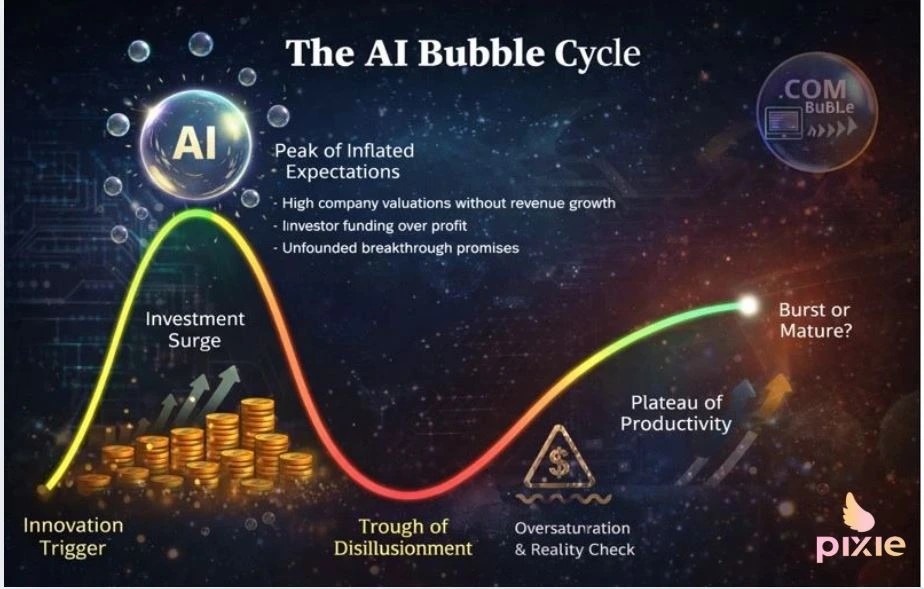
An AI bubble describes a situation where market enthusiasm, funding, and valuations around artificial intelligence outpace real-world results. Many companies receive large investments simply because they are associated with AI, even when their business models are still unclear.
Common characteristics linked to the AI bubble include:
- High company valuations without proportional revenue growth
- Heavy reliance on investor funding rather than operational profit
- Promises of future breakthroughs that have not yet materialised
This pattern feels familiar. During the dot-com era of the late 1990s, companies gained massive funding just by adding “.com” to their name. When profits failed to follow expectations, the bubble collapsed. The concern today is whether AI is repeating this cycle on a much larger scale.

Source: Unsplash
Why the Term AI Bubble Is Gaining Attention
Massive Investment With Uneven Returns
Global spending on AI infrastructure has reached historic levels. Companies are investing billions in GPUs, cloud computing, and data centres. Research from leading universities suggests that a large percentage of AI projects never reach the profitability initially promised. This gap between investment and outcome fuels the AI bubble narrative.
Profits Concentrated Among a Few Players
Much of the financial success in AI currently sits at the top of the supply chain. Companies like Nvidia benefit from selling high-demand AI chips, while many startups and service providers struggle to turn AI products into steady income. This imbalance raises concerns about long-term sustainability.
Public Statements From Industry Leaders
The conversation intensified when figures such as Sam Altman acknowledged signs of overinvestment and inflated expectations. When leaders inside the industry speak openly about bubble risks, market confidence naturally becomes more fragile.
Why People Fear the AI Bubble Bursting
Potential Impact on the Global Economy
AI investment has become a significant driver of economic growth, especially in the United States. A sharp correction could slow innovation, reduce hiring, and affect related industries such as cloud computing and semiconductor manufacturing. Because AI is deeply connected to other sectors, its downturn would not happen in isolation.
Rising Debt and Operational Costs
Training and running large AI models is expensive. Costs increase with usage, as each interaction requires substantial computing power. If expected revenue fails to arrive, companies may face cash flow issues, layoffs, or cancelled research projects.
Energy and Infrastructure Pressure
AI data centres consume enormous amounts of electricity and water. These ongoing expenses add another layer of financial risk, particularly if market enthusiasm cools before efficiency improves.
Will the AI Bubble Actually Burst?
Not everyone agrees that a dramatic collapse is coming. Many analysts believe the AI bubble will adjust rather than explode.
AI Already Generates Real Value
Unlike many dot-com startups, major technology firms already earn tangible profits from AI. Companies such as Microsoft, Google, and Amazon integrate AI into cloud services, advertising, productivity tools, and logistics. These applications deliver measurable economic benefits today.
Broad and Long-Term Use Cases
AI is applied across healthcare, education, finance, logistics, energy management, cybersecurity, and creative industries. This wide adoption suggests AI is not a short-lived trend but a foundational technology that will continue evolving over decades.
The Concept of a Rational Bubble
Some economists describe the current situation as a “rational bubble.” Investors are aware of the risks but choose to invest anyway because missing out on a technological transformation could be more costly than short-term losses. In this view, excess investment accelerates infrastructure development that future generations of AI systems will rely on.
What to Expect From AI in the Coming Years
Rather than a sudden crash, the AI bubble may slowly reshape itself. Expectations are likely to become more realistic, funding may shift toward proven use cases, and weaker companies may exit the market. This process can be healthy, allowing stronger, more practical AI solutions to thrive.
Key trends to watch include:
- Greater focus on efficiency and cost reduction
- Stronger regulation and governance
- Increased demand for explainable and responsible AI
- Integration of AI into existing workflows rather than standalone hype products
How to Respond Wisely to the AI Bubble Debate
Responding wisely to the AI bubble debate begins with understanding the technology itself. Taking time to learn how AI works, along with its current limitations, helps set realistic expectations and reduces unnecessary fear. When people understand what AI can and cannot do, they are better equipped to make thoughtful decisions rather than reacting to alarming headlines or exaggerated promises.
It is also important to resist the urge to follow hype blindly. For investors, this means avoiding overexposure to a single technology and maintaining a diversified approach. For businesses, it means adopting AI only when it addresses real needs, improves efficiency, or solves specific problems. Decisions driven by trends alone often lead to disappointment when expected results fail to materialise.
Beyond investment and strategy, AI can still offer practical value in everyday life. Even without putting money into AI-related assets, individuals can benefit from using AI tools for productivity, learning support, creative exploration, and research assistance. These applications provide tangible benefits regardless of market cycles, allowing people to engage with AI in a grounded and meaningful way.
Beyond the AI Bubble Narrative
The AI bubble discussion reflects a deeper tension between technological optimism and economic reality. While signs of overinvestment do exist, artificial intelligence is already delivering real benefits and continues to reshape industries across the globe. Any market correction that may occur is more likely to refine AI’s role, encouraging stronger business models and more practical applications rather than eliminating the technology altogether.
Rather than focusing only on whether the AI bubble will burst, a more constructive approach is to understand how AI can be used responsibly, strategically, and effectively. Staying informed, building realistic expectations, and applying technology where it creates tangible value will remain essential as the market evolves.
For businesses seeking thoughtful, results-driven digital strategies, Pixie Digital Marketing Agency Bali offers support beyond trends and hype. With a focus on clarity, creativity, and long-term growth, Pixie helps brands navigate the digital landscape with confidence.
