

Table of Contents
Google Ads that fails to generate conversions is usually caused by a combination of issues with targeting, the landing page, tracking, and campaign structure, not because the platform itself is ineffective. High traffic without conversions is often a sign of a mismatch between what the ad promises and what the visitor actually finds. This guide covers the most common reasons Google Ads campaigns fail to convert, how to diagnose them, and how to fix them.
What's a Good Google Ads Conversion Rate?
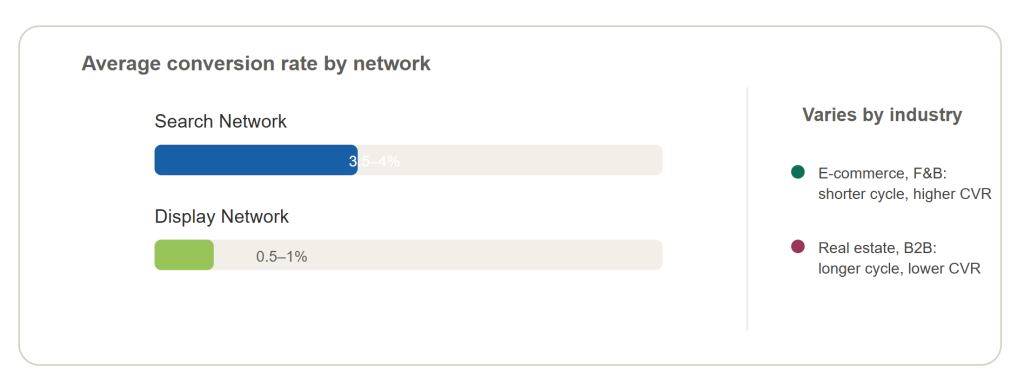
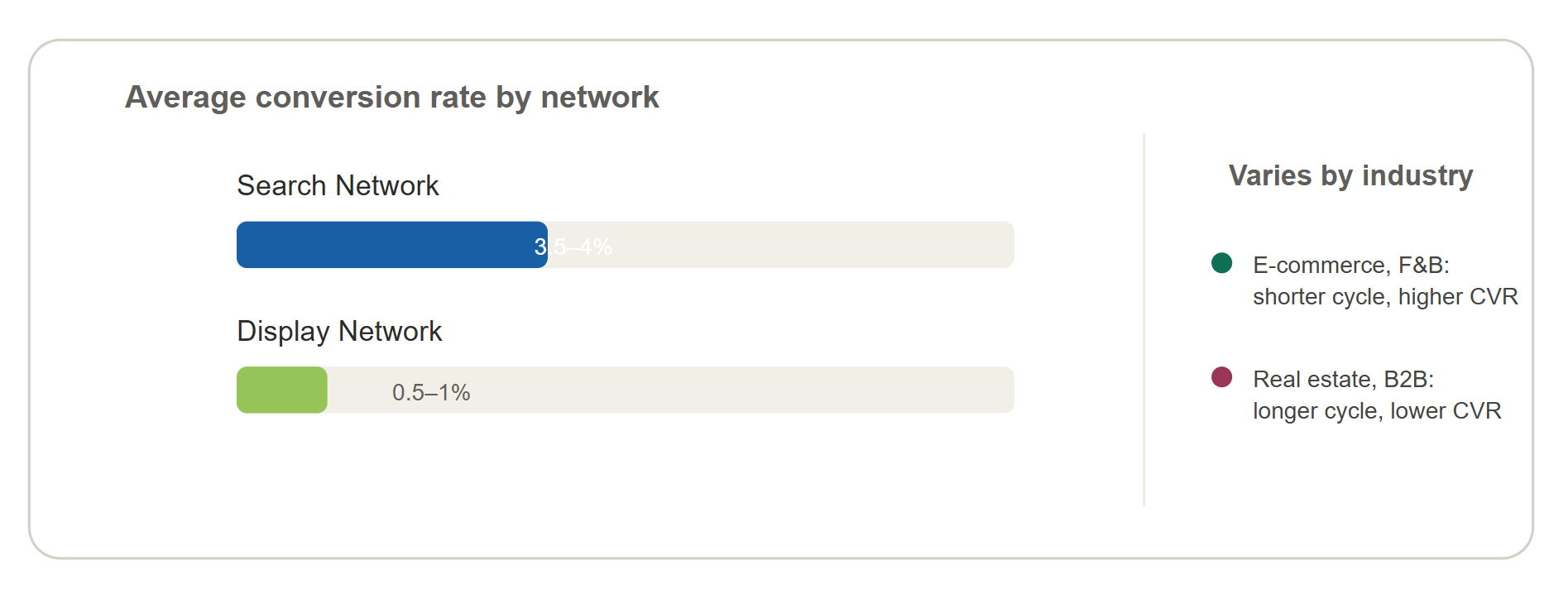
Average conversion rates run about 3.5–4% on the Search network and 0.5–1% on Display, though this varies by industry, short-cycle businesses like e-commerce and F&B tend to convert higher, while high-value, longer-decision industries like real estate or B2B convert lower.
What matters more than the industry benchmark is your own trend over time. A rate well below 1% in a short-cycle business, or a sharp drop with no major campaign changes, is an early signal worth digging into.
What Does "Not Converting" Actually Mean?

A conversion is the desired action a user takes after clicking an ad, a purchase, a form submission, a phone call. A campaign is considered “not converting” when:
- The ad gets clicks and traffic, but the conversion rate is extremely low or zero.
- Leads come in, but their quality is poor and they never turn into sales.
- No conversion data is recorded in the dashboard at all, even though real transactions are happening.
Each of these three conditions has different causes and different fixes, so the first step is figuring out which category your campaign falls into.
A Few Reasons Google Ads Isn't Converting
1. Conversion Tracking Isn't Installed Correctly
This is the most common cause, and the most commonly overlooked. If the conversion tracking tag isn’t placed on the right page, is firing twice (double counting), or breaks after a website update, the system won’t record conversions even though real transactions are happening.
Check with Google Tag Assistant or the “Diagnostics” menu in Google Ads to confirm the tag is active and correctly placed on the right confirmation page.
2. Targeting Is Too Broad or Irrelevant
Targeting overly broad keywords, locations, or audiences means your ad shows to people who don’t actually need your product or service. Traffic volume looks good, but its quality is low, which drags down the conversion rate.
Generic, ambiguous keywords (like “shoes” with no qualifier) tend to attract searchers with mixed intent, many of them are just researching, not ready to buy.
3. The Landing Page Doesn't Match the Ad

A message mismatch between the ad and the landing page is a common reason users abandon a page before converting. If the ad promises 30% off but the landing page doesn’t clearly show that offer, visitors feel misled and leave immediately.
A slow-loading landing page, a non-mobile-friendly layout, or a form that’s too long are also frequently overlooked conversion blockers.
4. Budget and Bidding Aren't Optimized
A budget that’s too small means losing auctions for competitive keywords, so the ad only shows in low-visibility positions. A bidding strategy that doesn’t match the campaign’s stage for example, using Target ROAS while conversion data is still minimal, can also make the algorithm learn incorrectly, hurting performance instead of helping it.
5. Low Quality Score
QA low Quality Score (driven by ad relevance, CTR, and landing page experience) means a higher CPC and a lower ad position for the same budget. The result is less traffic at a higher cost per click, which further reduces the chance of conversion.
6. A Messy Campaign Structure
Grouping many different products or services into a single ad group makes ads generic and less relevant to a user’s specific search. An overly broad campaign structure also makes it harder to analyze performance by product category.
7. The Funnel Doesn't Match Search Intent
Not every search is ready to buy right away. Targeting informational keywords (like “how to choose”) with an ad that sends users straight to checkout often fails to convert because the user isn’t at the purchase-decision stage yet.
8. Lack of A/B Testing

Many campaigns run for years with the same headline, copy, or landing page design, never testing an alternative. Without A/B testing, it’s hard to know whether your conversion rate is already at its ceiling or being held back by an element, headline, CTA, button color, form order, that could actually be improved.
Start with high-impact elements like headlines and CTAs before testing smaller details, and let each test run long enough to reach statistical significance rather than judging it off a few days of data.
9. High Competition
In a crowded, high-value niche, more advertisers are bidding on the same keywords, which drives CPC up and makes it harder to secure a top ad position. Even a well-optimized campaign can underperform simply because there’s more competition to outbid — not because anything is technically wrong. In these cases, differentiation (offer, price, unique selling point) matters as much as budget.
10. External and Internal Factors
Not every drop comes from the campaign itself. External factors seasonality, economic shifts, a competitor’s promo, algorithm updates, and internal ones a site redesign, checkout changes, stock issues, pricing updates, can quietly break what used to convert well. Check for changes outside the Google Ads account before blaming the strategy.
How to Diagnose a Conversion Problem
- Check your tracking report first. Confirm conversions really aren’t happening, not just that they’re not being recorded.
- Review the Search Terms Report. Look at the actual queries triggering clicks to assess traffic relevance.
- Analyze on-page behavior. Use a heatmap or Google Analytics to see where users drop off before converting.
- Compare CTR and Quality Score across keywords. A low CTR often signals an ad that isn’t relevant to the search.
- Check the device and time-of-day breakdown. A conversion imbalance on one device (e.g. mobile) can point to a technical issue there.
Solutions to Improve Google Ads Conversions
Fix Tracking First
Before changing any strategy, make sure your conversion data is accurate. Optimizing against bad data only makes the problem worse, not better.
Narrow Your Targeting
Focus on high-intent keywords and add negative keywords regularly. Narrow your location targeting to the areas that are genuinely relevant to your business’s reach.
Align Your Ad Message with the Landing Page
Make sure the headline, offer, and visuals on the landing page match what the ad copy promises. Simplify forms and speed up page load times.
Match Your Budget to the Campaign Stage
Use manual bidding or Maximize Clicks early on to gather data, then move to smart bidding (Target CPA/ROAS) once you have enough historical conversion data.
Clean Up Your Campaign Structure
Split ad groups by specific product or service category so ads stay relevant to what users are searching for, and so performance is easier to analyze.
Match Your Funnel to the Search Stage
Use a tiered approach: send informational keywords to educational content, and transactional keywords straight to a product or checkout page.
Run A/B Tests Regularly
Test one element at a time (headline, CTA, or form layout) so results are clearly attributable, and let each test run long enough to gather statistically significant data before drawing conclusions.
Conclusion
A conversion shortfall in Google Ads rarely comes from a single cause, it’s usually an accumulation of several smaller issues at once: mistracked conversions, overly broad targeting, an ad message that doesn’t match the landing page, and elements that have never been tested through A/B testing. The right approach is to work through them systematically, starting with validating the accuracy of your conversion data before moving on to more strategic optimization.
Need help diagnosing and improving your Google Ads campaign performance? The Pixie Digital team is ready to help you build a more focused, measurable strategy.